

Removable Gooseneck Trailer
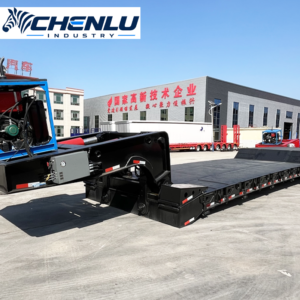
CHAPTER 1 — Hydraulic Detachable Gooseneck Lowboy Trailer Guide: Types, Uses, Structure & Buying Considerations
1-1. What Is a Hydraulic Detachable Gooseneck Lowboy Trailer?
A hydraulic detachable gooseneck lowboy trailer is a heavy-duty semi-trailer designed to transport tall, heavy and oversized equipment. Its defining feature is a gooseneck that can be detached from the trailer frame using a hydraulic system. This allows the front of the cargo deck to lower to the ground, so equipment can be driven or pulled onto the trailer from the front.
This type of trailer is also known as a removable gooseneck trailer, RGN trailer, detachable gooseneck lowboy, or front loading lowboy trailer. It is widely used for construction machinery, mining equipment, agricultural machines, military vehicles and other loads that cannot be loaded from the rear ramps of a standard lowbed trailer.
Unlike a conventional lowbed trailer, which usually loads from the rear using ramps, a hydraulic detachable gooseneck trailer provides a lower loading angle and better stability during loading. The gooseneck can be reattached after loading, restoring the trailer to its normal transport position.
1-2. How Does a Hydraulic Detachable Gooseneck Trailer Work?
The working principle of a hydraulic detachable gooseneck trailer is based on separating the gooseneck from the trailer body.
The main steps are:
- Connect the tractor to the trailer and ensure the hydraulic system is ready.
- Remove the locking pins and disconnect the air and electrical lines between the gooseneck and the trailer frame.
- Use the hydraulic system to lower the gooseneck until the front of the trailer touches the ground.
- Drive the tractor away with the gooseneck, leaving the trailer deck on the ground as a loading ramp.
- Load the equipment from the front onto the cargo deck.
- Reconnect the gooseneck, raise the trailer, and secure all locking pins and connections.
- Check the brake, lighting and coupling systems before departure.
This front-loading method is especially useful for equipment with a high center of gravity or a height that makes rear ramp loading difficult or unsafe.
1-3. What Can a Hydraulic Detachable Gooseneck Trailer Transport?
A hydraulic detachable gooseneck trailer is built for heavy and oversized cargo. Typical applications include:
- Excavators and bulldozers
- Wheel loaders and backhoes
- Pile drivers and rotary drilling rigs
- Cranes and lifting equipment
- Mining machinery
- Agricultural equipment such as tractors and combines
- Military vehicles and armored equipment
- Oil and gas industry equipment
- Transformers, generators and industrial machinery
- Other tall or heavy equipment that requires front loading
Because the deck can be lowered to the ground, the trailer can handle equipment that would be difficult to load onto a standard flatbed or lowbed trailer. The low deck height also helps reduce the overall transport height, which is important in areas with strict height regulations.
1-4. Hydraulic Detachable Gooseneck vs. Folding Gooseneck vs. Standard Lowbed Trailer
Different heavy-haul trailers use different loading methods.
Hydraulic Detachable Gooseneck Trailer
The gooseneck is completely separated from the trailer frame. The front of the deck lowers to the ground, allowing front loading. This design usually provides the strongest structure and is suitable for very heavy loads.
Folding Gooseneck Trailer
The gooseneck folds down to form a shallow ramp without being completely removed from the trailer body. It saves storage space and is easier to operate in some cases, but its structure may not be as strong as a detachable gooseneck for extreme loads.
Standard Lowbed Trailer
A standard lowbed trailer typically loads from the rear using hydraulic ramps. It is suitable for many types of construction machinery, but the ramp angle can be steep, and loading very tall equipment may be difficult.
The choice between these types depends on the cargo, loading method, required payload and operating conditions.
1-5. Common Types of Hydraulic Detachable Gooseneck Trailers
Hydraulic detachable gooseneck trailers can be classified by axle configuration and load capacity.
2-Axle Detachable Gooseneck Trailer
A 2-axle configuration is suitable for lighter heavy-haul applications where local regulations and payload requirements allow a smaller axle group.
3-Axle Detachable Gooseneck Trailer
The 3-axle detachable gooseneck trailer is one of the most common configurations. It offers a practical balance between payload, weight distribution and maneuverability. Common capacities include 60 tons, 80 tons and similar ranges.
4-Axle Detachable Gooseneck Trailer
A 4-axle configuration provides higher load capacity and better weight distribution for heavier equipment. It is often used for 100-ton to 120-ton applications.
Multi-Axle and Line-Axle Trailer
For very heavy loads, multi-axle or line-axle designs are used. Examples include 3-line 6-axle and 4-line 8-axle trailers. These configurations distribute the load over a larger number of axles and are suitable for 100-ton to 200-ton transport tasks.
The right configuration depends on the cargo weight, dimensions, local road regulations and the tractor used.
1-6. Hydraulic Detachable Gooseneck Trailer Dimensions: Length, Width, Deck Height and Ground Clearance
The dimensions of a hydraulic detachable gooseneck trailer are customized according to the cargo and operating requirements.
Typical parameters include:
- Effective cargo deck length: approximately 5,500 mm to 9,000 mm or longer for special applications
- Deck width: commonly 3,000 mm to 3,600 mm, with some designs reaching 4,000 mm
- Deck height (working surface): commonly around 800 mm to 900 mm, with 850 mm being a common design
- Ground clearance: depends on the suspension, axle configuration and tire size
The deck height can often be adjusted through the hydraulic system during operation. A lower deck height reduces the overall transport height and improves stability.
Other dimensions that need to be confirmed include:
- Overall trailer length
- Kingpin position
- Axle spacing
- Rear overhang
- Gooseneck length
- Ramp or loading angle
- Tire size
These dimensions should always be checked against local road regulations and the actual cargo.
1-7. How Much Weight Can a Hydraulic Detachable Gooseneck Trailer Carry?
The load capacity of a hydraulic detachable gooseneck trailer depends on the complete trailer design, not just the number of axles.
Important factors include:
- Main beam design and steel grade
- Gooseneck structure and hydraulic system
- Axle rating and quantity
- Suspension capacity
- Tire load rating
- Braking system
- Cargo distribution
- Local legal weight limits
Common design capacities include:
- 2-axle: lighter heavy-haul applications
- 3-axle: 60 tons to 80 tons
- 4-axle: 80 tons to 120 tons
- Multi-axle / line-axle: 100 tons to 150 tons or more, with some designs reaching 200 tons
The actual payload must comply with local regulations for gross vehicle weight, axle loads and bridge limits. Cargo should be distributed evenly to avoid excessive concentrated loads on the deck.
1-8. How Does the Hydraulic Gooseneck Detachment System Work?
The hydraulic detachment system is the core of a detachable gooseneck trailer.
The gooseneck is connected to the trailer frame through locking pins and hydraulic cylinders. When the operator activates the hydraulic system, the gooseneck can be lowered or raised. During detachment, the gooseneck is lowered until the front of the trailer rests on the ground. The locking pins are then removed, and the tractor drives away with the gooseneck.
After loading, the tractor reverses back, the gooseneck is reconnected, and the hydraulic system raises the trailer to its transport position. All locking pins and safety devices must be properly engaged before moving.
A reliable hydraulic system, correct maintenance and operator training are essential for safe operation.
1-9. Hydraulic Detachable Gooseneck Trailer Main Components Explained
A hydraulic detachable gooseneck trailer consists of several major components:
Gooseneck
The gooseneck connects the trailer to the tractor’s fifth wheel. It contains the hydraulic cylinders and locking mechanism for detachment.
Main Frame
The main frame includes longitudinal beams, cross members and side beams. It carries the cargo load and transfers forces to the suspension and axles.
Cargo Deck
The deck provides the loading surface. It may use high-strength steel plate, checkered plate or other materials depending on the application.
Hydraulic Power Station
The hydraulic system can be powered by a diesel engine or another power source. It operates the gooseneck and, in some designs, the suspension or ramps.
Axles and Suspension
Axles and suspension support the load and provide stability. Common configurations include mechanical suspension, bogie suspension and air suspension.
Braking System
The braking system may include air brake chambers, valves, ABS or EBS, depending on the specification.
Landing Gear
Landing gear supports the front of the trailer when it is disconnected from the tractor.
Cargo Securing Equipment
Lashing rings, chains, binders and other equipment are used to secure the cargo during transport.
1-10. How to Load and Secure Heavy Equipment on a Detachable Gooseneck Trailer
Safe loading starts with preparation.
Before loading:
- Inspect the trailer deck, tires, suspension, brakes and hydraulic system.
- Confirm that the trailer capacity is suitable for the cargo.
- Check the loading area and ground conditions.
- Ensure the gooseneck locking pins and hydraulic system are in good condition.
During loading:
- Detach the gooseneck and lower the front of the trailer to the ground.
- Drive or winch the equipment onto the deck.
- Position the cargo to achieve proper weight distribution.
- Keep the center of gravity as low and centered as possible.
- Apply the parking brake and secure the equipment with chains, straps or binders.
- Reattach the gooseneck and raise the trailer.
- Recheck all locking pins, air lines, electrical connections and cargo securement before departure.
Never rely only on the weight of the cargo to keep it in place. Proper securing equipment and correct loading procedures are essential.
1-11. Hydraulic Detachable Gooseneck Trailer vs. Other Heavy-Duty Semi-Trailers
Different heavy-haul trailers serve different purposes.
vs. Standard Lowbed Trailer
A standard lowbed trailer loads from the rear using ramps. A detachable gooseneck trailer loads from the front, which is safer for tall equipment.
vs. Flatbed Trailer
A flatbed trailer has a higher deck and is suitable for containers and general cargo. It cannot lower to the ground for front loading.
vs. Folding Gooseneck Trailer
A folding gooseneck trailer does not require complete detachment of the gooseneck, but it may have lower load capacity than a detachable gooseneck design.
vs. Container Chassis
A container chassis is dedicated to container transport. A detachable gooseneck trailer is designed for heavy machinery and oversized cargo.
The right trailer depends on the cargo type, weight, dimensions, loading method and local regulations.
1-12. How to Choose the Right Hydraulic Detachable Gooseneck Trailer
Choosing the right trailer starts with the transport requirement.
Consider:
- Cargo type: What equipment will be transported?
- Cargo weight: What is the normal and maximum weight?
- Cargo dimensions: Length, width, height and center of gravity.
- Loading method: Front loading, rear loading or crane loading.
- Axle configuration: 2, 3, 4 or multi-axle.
- Suspension: Mechanical, bogie or air suspension.
- Deck dimensions: Length, width and height.
- Hydraulic system: Power source and control method.
- Cargo securing: Chains, binders, lashing points.
- Road regulations: Local limits for weight, dimensions and axle loads.
- Tractor compatibility: Fifth wheel, kingpin and air connections.
A properly specified trailer should provide safe operation, adequate payload and compliance with local regulations.
1-13. Hydraulic Detachable Gooseneck Trailer Maintenance and Safety Checks
Regular maintenance is important for safe operation.
Key checks include:
- Hydraulic system: oil level, leaks, cylinder condition, hoses and fittings.
- Gooseneck locking pins: wear, damage and proper engagement.
- Main frame and welds: cracks, deformation or corrosion.
- Suspension and axles: leaks, worn parts, proper alignment.
- Brakes and air system: pressure, leaks, brake chamber condition.
- Tires: pressure, tread depth and damage.
- Lights and electrical system: function and connections.
- Cargo securing equipment: condition and strength.
Before each trip, perform a walk-around inspection and confirm that all locking pins, air lines and electrical connections are secure.
CHAPTER 2 — CHENLU INDUSTRY Hydraulic Detachable Gooseneck Trailer Manufacturing & Custom Solutions
2-1. CHENLU INDUSTRY Hydraulic Detachable Gooseneck Trailer Manufacturing Overview
CHENLU INDUSTRY designs and manufactures hydraulic detachable gooseneck lowboy trailers for heavy equipment transport, construction machinery, mining equipment and other oversized cargo.
Our trailers can be configured with different axle numbers, deck lengths, suspension systems, hydraulic systems and cargo-securing equipment. We approach each project from the complete transport requirement, considering the cargo, tractor, road conditions and local regulations.
Our product range includes 2-axle, 3-axle, 4-axle and multi-axle hydraulic detachable gooseneck trailers, with capacities from 60 tons to 150 tons or more.
2-2. How CHENLU Designs Detachable Gooseneck Trailers for Different Heavy Equipment
Different equipment requires different trailer designs.
A trailer for a large excavator may need a different deck length and axle configuration than a trailer for a bulldozer or a transformer.
CHENLU considers:
- Cargo type and weight
- Cargo dimensions and center of gravity
- Loading method
- Required deck length and width
- Axle load and configuration
- Suspension type
- Hydraulic system requirements
- Tractor specifications
- Local road regulations
For tall equipment, the deck height and loading angle are critical. For very heavy loads, the main beam and gooseneck structure are strengthened accordingly.
2-3. Main Beam and Steel Selection for Hydraulic Detachable Gooseneck Trailers
The main beams are the primary load-bearing structure of the trailer.
CHENLU can use high-strength structural steels such as Q460C and T700 for heavy-duty applications. These materials offer high yield strength and good toughness, allowing the trailer to handle heavy loads while keeping weight optimized.
Steel selection is not the only factor. The design must also consider:
- Beam profile and dimensions
- Web and flange thickness
- Cross-member spacing
- Welding quality
- Load distribution
- Concentrated load points
CHENLU treats steel selection and structural design as connected engineering decisions.
2-4. Gooseneck and Frame Structural Design
The gooseneck is a critical component. It must withstand high forces during loading, transport and detachment.
CHENLU designs the gooseneck with reinforced structures and reliable hydraulic cylinders. The locking mechanism is designed for secure engagement and easy operation.
The main frame is assembled from longitudinal beams, side beams and cross members. The frame must support the cargo load and transfer forces to the suspension and axles.
For different cargo types, the frame design can be adjusted to provide the required strength and stiffness.
2-5. Hydraulic System, Axles, Suspension, Tires and Braking Configuration
Hydraulic System
The hydraulic system can be powered by a diesel engine or another power source. CHENLU selects reliable hydraulic components and provides clear operation instructions.
Axles
Axle ratings are selected according to the required load and local regulations. Common heavy-duty axle brands such as FUWA or BPW can be used depending on the project specification.
Suspension
CHENLU can configure mechanical leaf spring, bogie or air suspension. Mechanical suspension is widely used for its simple structure and easy maintenance. Air suspension can be selected for applications requiring better ride characteristics.
Tires
Common tire specifications include 12R22.5, but other sizes can be configured according to the axle load and operating conditions.
Braking System
The braking system can include air brake chambers, WABCO valves, ABS or EBS as required. Braking performance is matched to the trailer’s load capacity and operating environment.
2-6. Deck and Loading System Configuration
The cargo deck can be customized for different equipment.
Options include:
- High-strength steel deck plate
- Checkered plate
- Lashing rings and lashing holes
- Removable side posts
- Hydraulic ramps (if required)
- Front loading gooseneck system
The deck height and loading angle are designed to match the cargo and loading method. For front loading, the gooseneck detachment system is configured to provide a safe and stable loading slope.
2-7. Dimensions and Customization Options
CHENLU can customize trailer dimensions according to the customer’s requirements.
Common parameters include:
- Overall length
- Cargo deck length
- Deck width
- Deck height
- Axle spacing
- Kingpin position
- Rear overhang
- Gooseneck length
- Tire size
Common deck lengths range from 5,500 mm to 9,000 mm or longer. Deck widths are typically 3,000 mm to 3,600 mm, with wider options available for special applications.
Customization should always be based on the actual transport requirement and local regulations.
2-8. Custom Hydraulic Detachable Gooseneck Trailers for Different Applications
CHENLU can configure trailers for:
Construction Machinery
Excavators, bulldozers, loaders, cranes and other construction equipment.
Mining Equipment
Large mining trucks, drills and loaders.
Agricultural Equipment
Tractors, combines and other farm machinery.
Oil and Gas Equipment
Drilling rigs, pipeline components and specialized machinery.
Military Vehicles
Tanks, armored vehicles and heavy military equipment.
Oversized Industrial Cargo
Transformers, generators, turbines and other heavy industrial components.
Each trailer is designed around the specific cargo and operating conditions.
2-9. CHENLU INDUSTRY Production Process
The production process includes:
- Engineering and Drawing – Trailer configuration is developed according to the customer’s requirements.
- CNC Cutting – Steel plates are cut accurately using CNC equipment.
- Main Frame Assembly – Main beams, side beams and cross members are assembled.
- Structural Welding – Frame components are welded according to production standards.
- Deck Installation – Cargo deck and securing equipment are installed.
- Surface Treatment – Cleaning, primer and finishing coatings are applied.
- Running Gear Installation – Axles, suspension, tires, brakes and landing gear are installed.
- Hydraulic System Installation – Gooseneck hydraulic system is installed and tested.
- Final Assembly and Inspection – All systems are checked before delivery.
A controlled process helps ensure consistency between the design and the finished trailer.
2-10. How CHENLU Inspects Hydraulic Detachable Gooseneck Trailers Before Delivery
Inspection covers both structural and functional aspects.
Checks include:
- Main beam and frame dimensions
- Weld quality
- Gooseneck locking mechanism
- Hydraulic system pressure and operation
- Axle and suspension installation
- Tire condition
- Brake system and air connections
- Electrical system and lighting
- Cargo securing equipment
- Deck surface and loading angle
The objective is to confirm that the trailer meets the approved specification and is safe for operation.
2-11. Painting, Protection and Shipping
After production and inspection, the trailer receives surface protection.
The frame is cleaned and painted with primer and finishing coats. For export shipping, additional protection such as wax coating and waterproof wrapping can be applied to reduce moisture and salt-water exposure.
Shipping methods include:
- Bulk vessel
- Ro-Ro
- Flat-rack container
- Other suitable marine transport
The method is selected according to trailer dimensions, quantity and destination.
2-12. CHENLU Hydraulic Detachable Gooseneck Trailer Configurations and Custom Solutions
CHENLU offers various configurations:
- 2-axle hydraulic detachable gooseneck trailer
- 3-axle hydraulic detachable gooseneck trailer
- 4-axle hydraulic detachable gooseneck trailer
- Multi-axle and line-axle trailers
- Customized deck length and width
- Mechanical, bogie or air suspension
- Different axle brands and capacities
- Various hydraulic power options
The goal is to provide a trailer that matches the customer’s actual transport needs without unnecessary specifications.
2-13. What Information Do You Need to Order a Hydraulic Detachable Gooseneck Trailer?
To configure a suitable trailer, CHENLU needs the following information:
- Cargo type and description
- Cargo weight (normal and maximum)
- Cargo dimensions (length, width, height)
- Loading method (front, rear, crane)
- Required deck length and width
- Axle configuration and capacity
- Suspension preference
- Hydraulic system requirements
- Tractor model and fifth wheel configuration
- Local road regulations (weight, dimensions, axle limits)
- Destination and shipping requirements
With this information, CHENLU can recommend the appropriate trailer dimensions, frame structure, axle configuration, suspension and hydraulic system.
A detailed specification before production helps reduce changes and ensures the finished trailer is built around the customer’s actual transportation needs.
Send Inquiry
Tell us the trailer model, quantity, destination port and your main transport cargo. Our sales team will reply with a suitable configuration.